
Professional Diploma in TV Report Preparation and Production
Program Specification
Field and Subfield: Journalism and Media / Television Production and Fieldwork
1. Program Overview:
An integrated professional and applied program extending over 3 months (80 accredited study-load hours), aimed at preparing and qualifying journalists, reporters, and visual-content creators to produce professional television and field reports in accordance with international standards. The program covers the complete television-report production cycle, beginning with research and investigation and identifying the journalistic angle (Angle); building the dramatic structure and storytelling; rules for writing text for the image; techniques for conducting quick field interviews (Vox Pop); visual planning and preparing the storyboard; principles of television filming and adjusting lighting and angles; voice-over skills (Voice Over); through to television editing, the use of graphics, and ethical, legal, and security standards.
2. Key Objectives:
- Understanding television-report formats and the arts of television storytelling: Understanding the fundamental differences between the news report, short report, and human-interest story report, and accurately identifying the journalistic treatment angle (Angle).
- Mastering television writing for the image: Mastering the rules of writing for both the ear and the eye, and adapting words to serve the visual scene and sound effects.
- Mastering field planning and television filming: Preparing the storyboard (Storyboard), selecting shot sizes, camera angles, and appropriate lighting, and professionally conducting street and source interviews.
- Voice-performance and editing skills: Training in delivery, vocal tone, and news voice-over (Voice Over), and building visual rhythm through editing and integrating graphics and background music.
- Compliance with legal and ethical standards: Observing the rules of journalistic work, verifying information, and protecting the security and safety of field crews.
3. Target Audience:
- Reporters and field journalists wishing to develop television and digital production skills.
- Creators of short documentary films and visual content for digital platforms.
- Photographers and editors seeking to understand the dramatic and editorial construction of reports.
- Graduates and students of journalism and media, political science, and mass communication colleges.
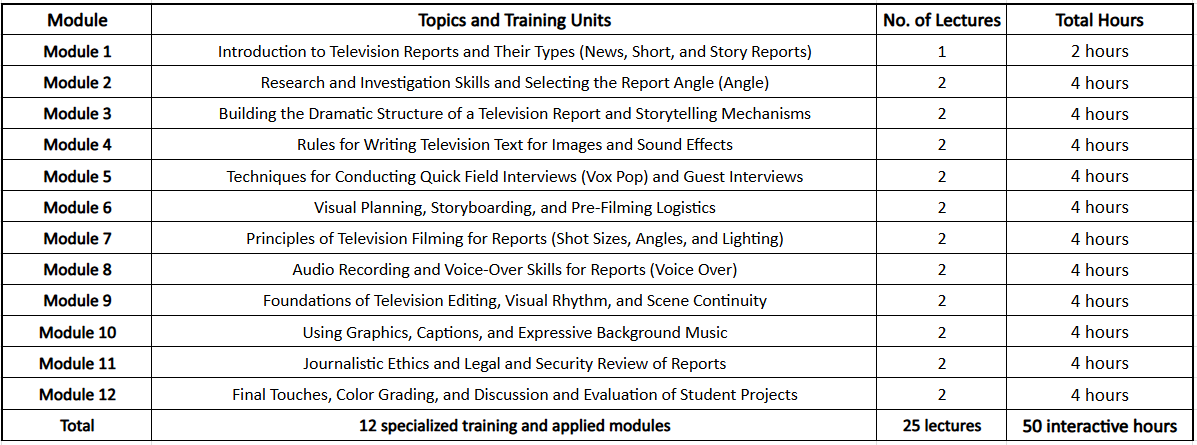
4. Study Plan and Modules (12 Modules — 25 Interactive Lectures):
5. Organizational Structure and Assessment System:
- Duration and Schedule: 3 months (evening period), at a rate of two lectures per week, two hours per lecture = 25 lectures / 50 direct interactive hours.
- Training Language and Delivery Method: Arabic language | Fully online interactive and applied training (Online).
- Distribution of Accredited Hours (80 total hours):
50 hours: Direct and interactive online lectures.
20 hours: Fieldwork applications and independent production.
7 hours: Analysis and review of international television reports.
3 hours: Evaluation and discussion of final graduation projects.
- Assessment System and Attendance Requirements: Attendance of no less than 75% of lectures, with continuous assessment based on assignments, practical field training, and examinations.
- Certificate and Graduation Project: The graduate is awarded the Professional Diploma in TV Report Preparation and Production after completing and having the final graduation project evaluated: producing a complete filmed television report (idea, script, filming, editing, and voice-over).
Join Request
